Tuesday, 30 October 2012

Hill Palace Museum


The Hill Palace Museum


Hill Palace is the largest archaeological museum in Kerala, near Tripunithura, Kochi, It was the administrative office of Kochi Rajas. Built in 1865, the Palacecomplex consists of 49 buildings in the traditional architectural style, spreading across in 54 acres (220,000 m2). The complex has an archaeological museum, a heritage museum, a deer park, a pre-historic park and a children’s park. The campus of the museum is home to several rare species of medicinal plants. Presently the palace has been converted into a museum by The Kerala State Archaeology Department and is open to public all days except Mondays from 9:00 am to 1:00 pm and 2:00 pm to 5:00 pm. 

Thripunithura Hill palace Museum, is the largest archaeological museum in Kerala and the erstwhile official residence of the Cochin Royal Family, was built in 1865. The palace complex consists of 49 buildings in the traditional architectural style of Kerala and is surrounded by 52 acres of terraced land with ponds, fountains, garden and lawns. A full fledged ethno archaeological museum and Kerala's first ever Heritage museum are the main attractions here. Hill Palace is located 16km east of Cochin in Trippunithura, a satellite town of Cochin.

In 1980, the palace was taken over by the Department Of Archaeology and later converted into a Museum. It was opened to the public in 1986. Set on top of a hillock and surrounded by terraced garden with fountains, ponds and lawns, this palace-turned-museum displays 14 categories of exhibits including paintings, murals, sculpture in stone and plaster of paris, manuscripts, inscriptions, carvings etc. Recently, the museum has been renovated by Archaeological Department with a few additions such as a two-metre wide walkway built around the palace complex lit by fancy lamps on decorated cast iron pillars and two hundred lamp posts to light up the locale during early morning and at night. Apart from repairing and restoring the doors and windows, Archeology Department also done 

Thursday, 25 October 2012

Bhadra Fort


The Bhadra Fort


The Bhadra Fort of Ahmedabad is another place to be visited in the city. The place is a venue for Republic Day and Independence Day celebrations in Ahmedabad. This fort of Ahmedabad fort has a temple devoted to the Mother Goddess, Bhadrakali; hence the name Bhadra Fort. Once housed royal palaces and beautiful gardens. It has the temple of Bhadrakali and was built in 1411 during the Maratha rule. The huge and grand Teen Darwaza (Triple Gateway) is another place to be seen in Ahmedabad. Teen Darwaza servedthe purpose of a royal entrance to the Royal Square of the Bhadra Fort.


This fort is also famous for abiding famous Bhadrakali Temple which is dedicated to Hindu goddess, 'Bhadra' (incarnation of goddess Kali). This Hindu sanctum was built in 1411 A.D. during Maratha rule in Ahmedabad. These days, the fort has been converted to flag hosting ground during Independence and Republic Day celebrations in India. It also houses some government offices within its vicinity. 


When it comes to monuments in Ahmedabad, Bhadra fort is one name that indeed deserves a special mention. Constructed in the year 1411 A.D. during the rule of Marathas, it was established by Sultan Ahmed Shah, the founder of Ahmedabad city. Bhadra fort in Ahmedabad is a royal fort that occupies the top most position in the Ahmedabad sightseeing tour. The fort houses a magnificent palace, the arches and balconies of which are ornately embellished. People are of the belief that, Goddess Lakshmi had once visited the Bhadra fort and blessed the Sultan that, his city would always remain prosperous. Since times immemorial, people of Ahmedabad have been wealthy and infact, Ahmedabad has throughout been the hub of trade and commerce in the state of Gujarat.

Tuesday, 23 October 2012

Daulatabad fort


Daulatabad fort


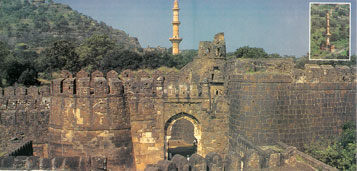
Daulatabad fort, in Aurangabad is a rare kind of construction, which is a combination of the ground fort and the hill fort. The imposing fort is built on an isolated pyramid-shaped natural mountain peak. The rock around is chiselled sklifully making the climb impossible.


The fort area is sorrounded by three concentric walls (fortifications) known as kots. The outer one, Amberkot covers the Daulatabad old town (a few shopts on both sides of the road). The National Highway 211, connecting Aurangabad to Ellora passes through the area covered by Amberkot.The second one, Mahakot, is currently the boundary of the fort for all practical purposes. Around Mahakot, sorrounding the fort is a water body (it is dry now). The main entrance is in Mahakot and has eight gates. The third one is Kalakot.

It is believed that this fort, originally known as Deogiri, was built by theRashtrakuta kings, who built the world famous Kailas caves. The earliest recorded history is that Yadav dynasty ruled this fort between 1187 to 1318 AD. In 1294, Alauddin Khilji attacked this fort, but the kingdome remained with the then rulers under a treaty. This was followed by Malik Kafur's attack in 1307 and later by Qutubuddin Mubarak Khilji in 1318.

The most noteworthy monuments inside the fort are Jami Masjid, Bharatmata Mandir, the Chand Minar, Elephant Tank, Royal Places and 'Chini Mahal' or Chinese Palace. 

Built by Ala-ud-din Bahmani in the honor of his conquest of the fort in 1435, the Chand Minar is a 30 m high tower inside the Fort. It was used as a prayer hall and comprised of four storeys. 

'Chini Mahal' or Chinese Palace has a great significance in the history. It is located a little higher than Chand Minar. The last king of Golcunda, Abdul Hasan Tana Shah was imprisoned here for 13 years until his death by the Mughal emperor Aurangzeb. 

Jami Masjid was built by Qutub-ud-din Mubarak in 1318. It is a mosque inside the fort comprising 106 pillars. 

The large Elephant Tank was the water supply system of the Fort. The water was channeled through the two enormous terracotta pipes from the hills into the fruit and vegetable gardens.