Showing posts with label world travel. Show all posts
Friday, 16 November 2012
The Statue of Liberty
Friday, 9 November 2012
Tate Modern
Tate Modern
Tate Modern is a modern art gallery located in London, England. It is Britain's national gallery of international modern art and forms part of the Tate group (together with Tate Britain, Tate Liverpool, Tate St Ives and Tate Online). It is the most-visited modern art gallery in the world, with around 4.7 million visitors per year. It is based in the former Bankside Power Station, in the Bankside area of Central London. Tate holds the national collection of British art from 1500 to the present day and international modern and contemporary art.
TATE Modern is the United Kingdom’s national museum of modern art. TATE Modern opened in 2000 and fast became one of the most celebrated London attractions with art enthusiasts. There is no admission fee to the gallery, making it one of the most popular free attractions in London. The gallery is based at Bankside on the Thames’ southbank, just yards from the Shakespeare Globe Theatre.
The galleries are housed in the former Bankside Power Station, which was originally designed by Sir Giles Gilbert Scott, the architect of Battersea Power Station, and built in two stages between 1947 and 1963. The power station closed in 1981. The building was converted by architects Herzog & de Meuron and contractors Carillion,after which it stood at 99m tall. The history of the site as well as information about the conversion was the basis for a 2008 documentary Architects Herzog and de Meuron: Alchemy of Building & Tate Modern.
The southern third of the building was retained by the French power companyEDF Energy as an electrical substation (in 2006, the company released half of this holding).TATE Modern houses a wonderful range of modern art, dating from the year 1900 up to today. The gallery’s main areas are the following: ‘Material Gestures’, devoted to abstract works of the 1940s and '50s; ‘Poetry and Dream’, a celebration of surrealistic works; ‘Scale’, which examines the practice of using scale to alter perception; ‘Energy and Process’, which looks at artists’ fascination with transformation and natural forces, and focuses on 1960s sculptural pieces; and ‘States of Flux’, which is devoted to early 20th-century art movements, such as pop art. TATE Modern's permanent exhibitions include works by such iconic 20th-century figures as Pablo Picasso and Salvador Dali.
The British Museum
British Museum
The British Museum is a museum in London dedicated to human history and culture. Its permanent collection, numbering some eight million works,is amongst the largest and most comprehensive in existence and originates from all continents, illustrating and documenting the story of human culture from its beginnings to the present.
The British Museum was established in 1753, largely based on the collections of the physician and scientist Sir Hans Sloane. The museum first opened to the public on 15 January 1759 in Montagu House in Bloomsbury, on the site of the current museum building. Its expansion over the following two and a half centuries was largely a result of an expanding British colonial footprint and has resulted in the creation of several branch institutions, the first being the British Museum (Natural History) in South Kensington in 1887. Some objects in the collection, most notably the Elgin Marbles from the Parthenon, are the objects of intense controversy and of calls for restitution to their countries of origin.
The world-famous British Museum exhibits the works of man from prehistoric to modern times from around the world. Highlights include the Rosetta Stone, the Parthenon sculptures, and the mummies in the Ancient Egypt collection. Entry is free but special exhibitions require tickets.
'By the 1970s, there was an active programme of gallery refurbishments and an education service and publishing company had been established. Additional public facilities were provided in a series of building works. These included the Duveen Gallery, built to house the Parthenon Sculptures (1939/62).
In 1973 the library became part of a new organisation, the British Library. This organisation remained at the Museum until 1997, when the books left Bloomsbury for a new building at St Pancras.The Queen Elizabeth II Great Court, built in the space vacated by the library, reflects the most recent public expansion at the Museum. At two acres, it is the largest covered public space in Europe. In the centre is the restored Reading Room, while around and beneath it new galleries and an education centre were built.
Monday, 5 November 2012
Golden Temple
The Golden Temple is surrounded by a large man-made lake – a lake which is closely linked to the temple and the surrounding city. In 1573 the construction of the lake started under supervision of the fourth guru of Sikhism; Guru Ram Das Ji. The lake stood complete four years later, in 1577.During this time, a city began to grow around the lake. The name of the city was originally “Ramdaspur” - after the guru - but it was later changed. As the city became associated with the construction of the lake, the city simply took the same name as the lake itself. Therefore, both the city and the lake carry the name Amritsar.
The entrance to the Golden Temple complex is through an ornate archway with intricate inlay work. Verses from the Granth Sahib are inscribed on the doorway. The main north entrance is under a Victorian clock tower. Known as the Darshani Deori, the entrance is up a flight of steps and down again to the temple and holy tank. The temple is a two storey marble structure reached by a causeway known as Guru´s Bridge. The lower storey is in white marble with the walls decorated with inlaid flower and animal motifs in the pietradura style of the Taj Mahal. The architecture of the golden temple is a blend of the Hindu and Muslim styles.
The temple building has four entrances instead of the usual single entry. This is symbolic of the openness of Sikhism and indicates that followers of all faiths are allowed inside. The walls within are decorated with carved wooden panels and elaborate inlay work in silver and gold. The Adi Granth, compiled by Guru Arjan Dev, rests on a throne beneath a jewel-encrusted canopy. Priests conduct continuous recitation of verses from the holy book in 3-hour shifts. A complete reading of the text stakes 48 hours. The original copy of the Guru Granth Sahib is kept under pink shroud in the, Golden Temple during the day and at around 10 p.m. each day is ceremoniously returned to the Akal Takht (Sikh Parliament) building. The morning processional ceremony takes place at 4 a.m. in Summer and at 5 a.m. in Winter, when Sri Guru Granth Sahib is bought from Akal takhat Sahib in a procession to the Sanctum Sanctorum, which is washed with milk.
The majority of these attacks happened during mid 18th century. This was the period when the temple was attacked numerous times by Afgahn raiders. The raiders caused severe damage to the temple complex, which resulted in a restoration of the temple in 1764. Another major assault on the Golden Temple was in 1984 when the Indian army attacked during the so called “Operation Bluestar”. The Indian army had order to move in to the temple area and remove Sikh militants who was believe to amass weapons inside the area. The operation ended in bloody gunfights between the militants and the army, resulting in large casualties on both sides.
The old city, with the Golden Temple and surrounding bazaars along narrow alleys, is encircled by a ring road. Even today, the markets have an ambience of ancient times, when traders bought and sold goods right across from central Asia up to the farthest corners of India. Little light reaches down to the congested streets, which are best negotiated on foot. There are rows upon rows of shops on each street selling specifics goods. Guru Bazaar specialises in gold jewellery shops, while the Bazaar Kesarian is for steel and brass utensils. The smells of Katra Kathian announce its wares before you reach the shops selling papads, warian (crispies made from pulses) murabbas (Indian jams), pickles and ampapad (dried mango candies). The Mishri Bazaar is the place to buy dry fruits, while Katra Mohan Singh offers a colourful kaleidoscope of bridal glass bangles.
Tuesday, 30 October 2012
Hill Palace Museum
The Hill Palace Museum
Hill Palace is the largest archaeological museum in Kerala, near Tripunithura, Kochi, It was the administrative office of Kochi Rajas. Built in 1865, the Palacecomplex consists of 49 buildings in the traditional architectural style, spreading across in 54 acres (220,000 m2). The complex has an archaeological museum, a heritage museum, a deer park, a pre-historic park and a children’s park. The campus of the museum is home to several rare species of medicinal plants. Presently the palace has been converted into a museum by The Kerala State Archaeology Department and is open to public all days except Mondays from 9:00 am to 1:00 pm and 2:00 pm to 5:00 pm.
Thripunithura Hill palace Museum, is the largest archaeological museum in Kerala and the erstwhile official residence of the Cochin Royal Family, was built in 1865. The palace complex consists of 49 buildings in the traditional architectural style of Kerala and is surrounded by 52 acres of terraced land with ponds, fountains, garden and lawns. A full fledged ethno archaeological museum and Kerala's first ever Heritage museum are the main attractions here. Hill Palace is located 16km east of Cochin in Trippunithura, a satellite town of Cochin.
In 1980, the palace was taken over by the Department Of Archaeology and later converted into a Museum. It was opened to the public in 1986. Set on top of a hillock and surrounded by terraced garden with fountains, ponds and lawns, this palace-turned-museum displays 14 categories of exhibits including paintings, murals, sculpture in stone and plaster of paris, manuscripts, inscriptions, carvings etc. Recently, the museum has been renovated by Archaeological Department with a few additions such as a two-metre wide walkway built around the palace complex lit by fancy lamps on decorated cast iron pillars and two hundred lamp posts to light up the locale during early morning and at night. Apart from repairing and restoring the doors and windows, Archeology Department also done
Thursday, 25 October 2012
Bhadra Fort
The Bhadra Fort
The Bhadra Fort of Ahmedabad is another place to be visited in the city.
The place is a venue for Republic Day and Independence Day celebrations in
Ahmedabad. This fort of Ahmedabad fort has a temple devoted to the Mother
Goddess, Bhadrakali; hence the name Bhadra Fort. Once housed royal palaces and
beautiful gardens. It has the temple of Bhadrakali and was built in 1411 during
the Maratha rule. The huge and grand Teen Darwaza (Triple Gateway) is another
place to be seen in Ahmedabad. Teen Darwaza servedthe purpose of a royal
entrance to the Royal Square of the Bhadra Fort.
This fort is also famous for abiding famous
Bhadrakali Temple which is dedicated to Hindu goddess, 'Bhadra' (incarnation of
goddess Kali). This Hindu sanctum was built in 1411 A.D. during Maratha rule in
Ahmedabad. These days, the fort has been converted to flag hosting ground
during Independence and Republic Day celebrations in India. It also houses some
government offices within its vicinity.
When it comes to monuments in Ahmedabad, Bhadra
fort is one name that indeed deserves a special mention. Constructed in the
year 1411 A.D. during the rule of Marathas, it was established by Sultan Ahmed
Shah, the founder of Ahmedabad city. Bhadra fort in Ahmedabad is a royal fort
that occupies the top most position in the Ahmedabad sightseeing tour. The
fort houses a magnificent palace, the arches and balconies of which are
ornately embellished. People are of the belief that, Goddess Lakshmi had once
visited the Bhadra fort and blessed the Sultan that, his city would always
remain prosperous. Since times immemorial, people of Ahmedabad have been
wealthy and infact, Ahmedabad has throughout been the hub of trade and commerce
in the state of Gujarat.
Tuesday, 23 October 2012
Daulatabad fort
Daulatabad fort
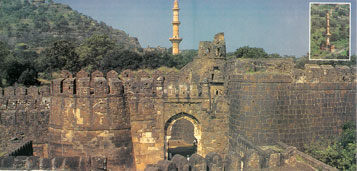
Daulatabad fort, in Aurangabad is a rare kind of construction, which is a combination of the ground fort and the hill fort. The imposing fort is built on an isolated pyramid-shaped natural mountain peak. The rock around is chiselled sklifully making the climb impossible.
The fort area is sorrounded by three concentric walls (fortifications) known as kots. The outer one, Amberkot covers the Daulatabad old town (a few shopts on both sides of the road). The National Highway 211, connecting Aurangabad to Ellora passes through the area covered by Amberkot.The second one, Mahakot, is currently the boundary of the fort for all practical purposes. Around Mahakot, sorrounding the fort is a water body (it is dry now). The main entrance is in Mahakot and has eight gates. The third one is Kalakot.
It is believed that this fort, originally known as Deogiri, was built by theRashtrakuta kings, who built the world famous Kailas caves. The earliest recorded history is that Yadav dynasty ruled this fort between 1187 to 1318 AD. In 1294, Alauddin Khilji attacked this fort, but the kingdome remained with the then rulers under a treaty. This was followed by Malik Kafur's attack in 1307 and later by Qutubuddin Mubarak Khilji in 1318.
The most noteworthy monuments inside the fort are Jami Masjid, Bharatmata Mandir, the Chand Minar, Elephant Tank, Royal Places and 'Chini Mahal' or Chinese Palace.
Built by Ala-ud-din Bahmani in the honor of his conquest of the fort in 1435, the Chand Minar is a 30 m high tower inside the Fort. It was used as a prayer hall and comprised of four storeys.
'Chini Mahal' or Chinese Palace has a great significance in the history. It is located a little higher than Chand Minar. The last king of Golcunda, Abdul Hasan Tana Shah was imprisoned here for 13 years until his death by the Mughal emperor Aurangzeb.
Jami Masjid was built by Qutub-ud-din Mubarak in 1318. It is a mosque inside the fort comprising 106 pillars.
The large Elephant Tank was the water supply system of the Fort. The water was channeled through the two enormous terracotta pipes from the hills into the fruit and vegetable gardens.
Tuesday, 9 October 2012
Qutub Minar
The Qutub Minar
Qutub Minar is the pride of Delhi. The tall minaret was constructed in 1192 by Qutab-ud-din Aibak, and later completed by his successor Iltutmish. The soaring conical tower is an exquisite example of Indo-Islamic Afghan architecture.
Qutub Minar is a World Heritage Site and has survived the ravages of time impressively. The Minar of Delhi is surrounded by a lush green garden, which is an ideal leisurely place for visitors. Qutab Minar is the favourite destination of tourists. It is India's most visited monument attracting around 3.9 million visitors every year.
Each of the 5 storeys and tower of Qutub Minar has unique designs.
It was hit by lightening couple of times and was damaged. The subsequent rulers repaired it. Thus it is standing mightily as it was before till date.
Qutab Minar is a great masterpiece of Mughal architecture. The base of the Qutub Minar measures 14.32 meters and the top of the structure measures 2.75 meters. The bird eye's view of Delhi city from the top is amazing. The base of first storey has alternate angular and circular flutings, the second one is round. The third storey of the Qutub Minar has angular flutings. The balconies projecting out heighten the beauty of the Minar.
The tower is so high that around 379 steps are needed to be climbed to reach the top. Another taller tower adjacent to Qutub Minar is named Alai Minar which is somewhat tilted in one direction.
The verses from the holy Qur'an are carved on sandstone walls of Qutub Minar. This monument serves the purpose of calling people for prayer in the Quwwat-ul-Islam mosque. This is a tower of victory, a monument that signify the might of Islam, or a tower for keeping a check for defense.
Subscribe to:
Posts (Atom)